

Why Texas Channels Won't Come In on an Antenna, and When You Need a VHF Antenna
When a Texas channel won't come in on an antenna, there are three usual suspects. The station broadcasts on VHF, its tower is too far away, or it stands in a different direction from the others. Many big Texas stations still use VHF-High, channels 7 to 13, and most small flat antennas are built for UHF. An antenna rated for VHF and UHF, aimed with the FCC's reception map, fixes most cases.
The same complaint turns up in every corner of the state: "I get everything except ABC," or "FOX keeps dropping out." The details change by city, but the physics doesn't. This guide explains the three common causes, lists the major Texas stations still on VHF, and walks through the fixes from cheapest to most involved. Where an antenna simply can't do the job, it says so.
Texas antenna reception at a glance
- Most common cause
- A VHF station and a UHF-only antenna
- VHF examples
- ABC 13 Houston, WFAA 8 Dallas, FOX 7 Austin, KIII 3 Corpus Christi, FOX 34 Lubbock
- What to buy
- An antenna that lists VHF-High, channels 7 to 13, and UHF
- Before you buy
- Check your address on the FCC's DTV reception map
- After any change
- Run a full channel rescan
The number on screen isn't the channel in the air
Your TV shows a station's "virtual" channel, but the antenna has to catch its real broadcast channel, and the two are often different. ABC 13 in Houston really is on channel 13. FOX 34 in Lubbock, though, broadcasts on channel 11, and NBC 2 in Houston on channel 35.
Virtual numbers let stations keep the channel viewers knew before 2009, when analog TV ended. The real channel decides which band the signal uses: VHF for 2 through 13, UHF for 14 through 36. That band, not the number on screen, decides what kind of antenna you need.
Cause 1: the station is on VHF, so you need a VHF antenna
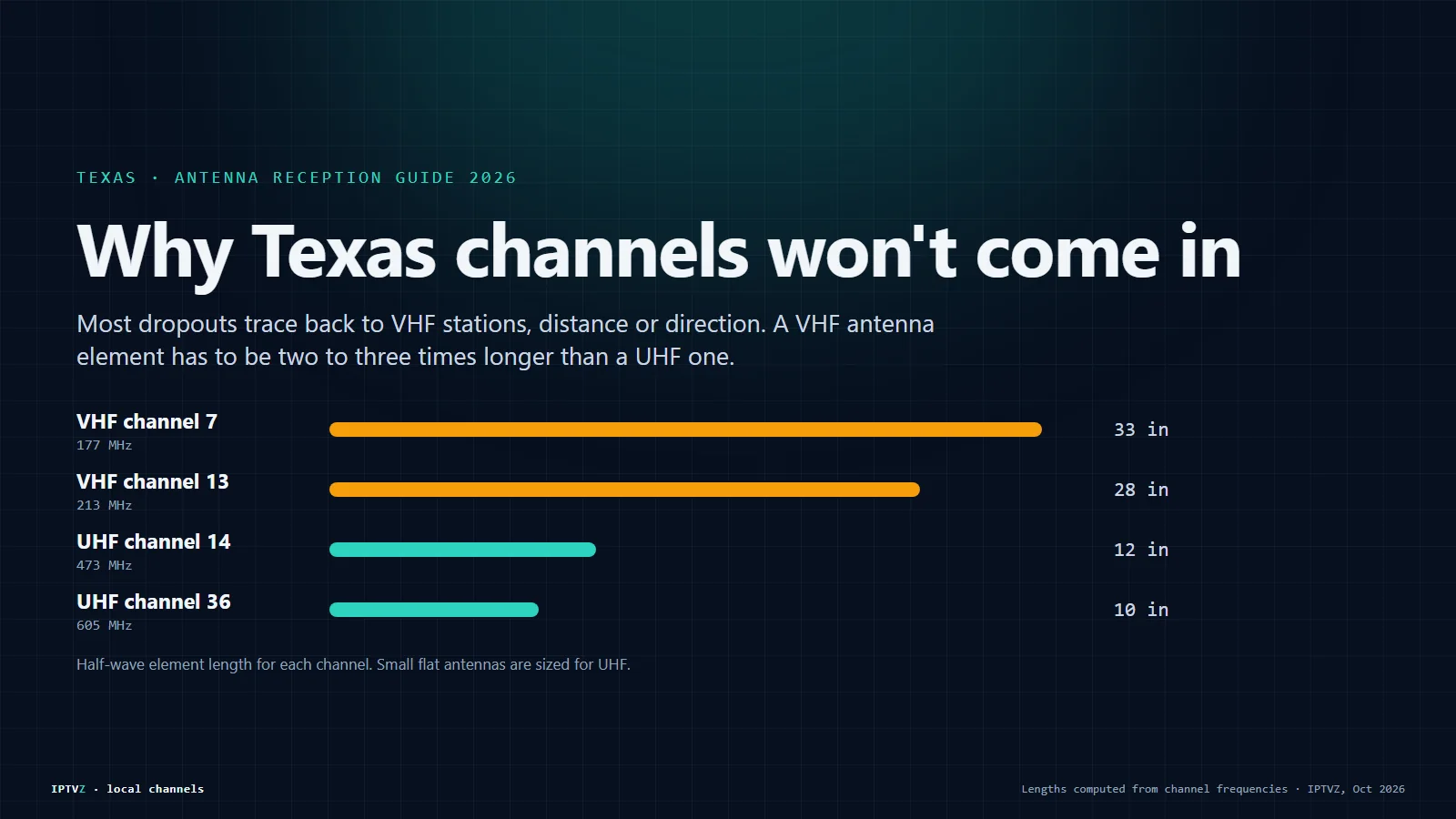
VHF signals need longer antenna elements than UHF ones. A half-wave element for channel 7 is about 33 inches long, and for channel 13 about 28 inches. For UHF channel 36 it's about 10 inches.
Most thin, flat indoor antennas are built around UHF, because most stations moved there. They pick up VHF weakly or not at all. So the classic symptom is a scan that finds nearly every channel except one or two, and those turn out to be the VHF stations. Look for an antenna that lists "VHF-High" or "channels 7 to 13" on the box, not just "HD" or a mileage claim.
Major Texas stations still on VHF
Every one of these broadcasts on VHF-High, so a UHF-only antenna may miss it.
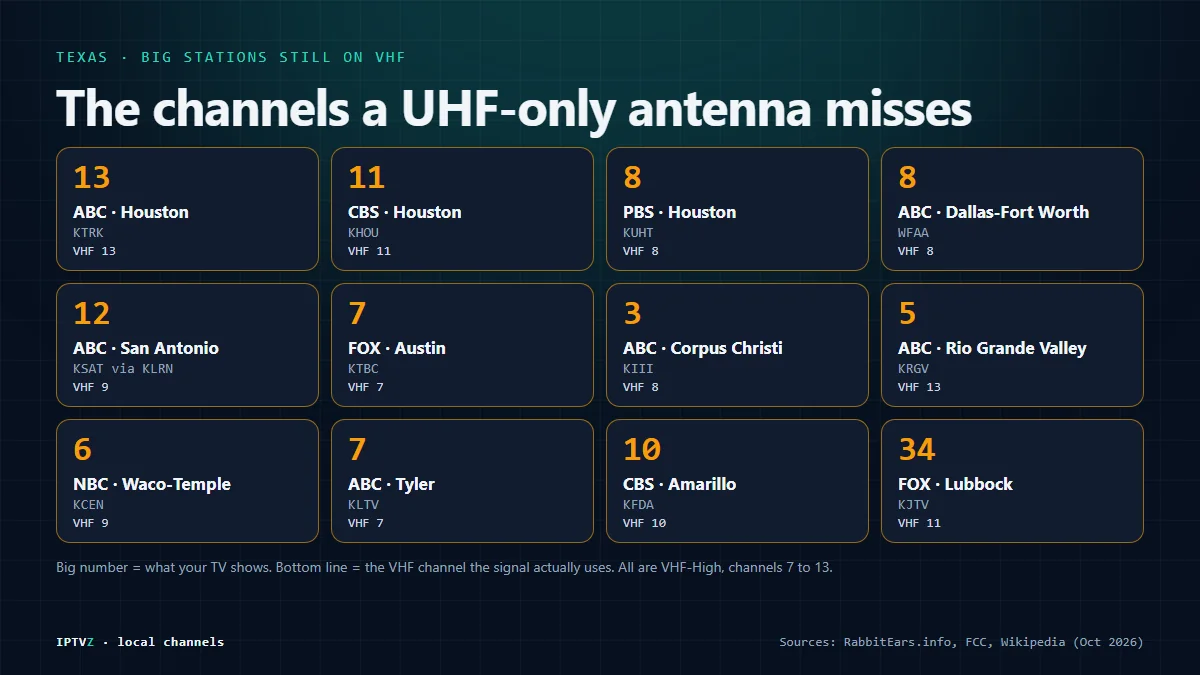
| Market | Station on VHF | On your TV | Broadcast channel |
|---|---|---|---|
| Houston | ABC KTRK, CBS KHOU, PBS KUHT | 13, 11, 8 | VHF 13, 11, 8 |
| Dallas-Fort Worth | ABC WFAA | 8 | VHF 8 |
| San Antonio | ABC 12 and PBS 9 on KLRN's signal | 12, 9 | VHF 9 |
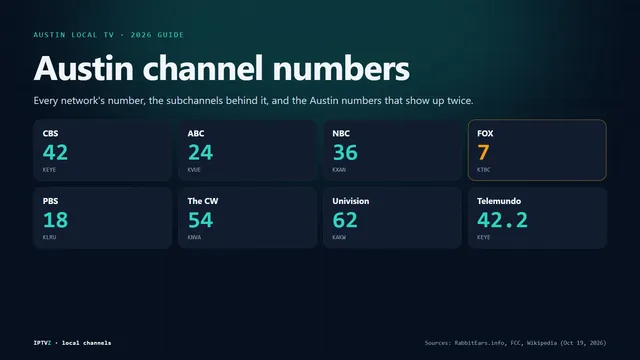
| Austin | FOX KTBC; Univision KAKW | 7, 62 | VHF 7, VHF 13 |
| El Paso | PBS KCOS | 13 | VHF 13 |
| Corpus Christi | ABC KIII; CBS KZTV | 3, 10 | VHF 8, VHF 10 |
| Victoria | FOX KVCT | 19 | VHF 11 |
| Rio Grande Valley | ABC KRGV | 5 | VHF 13 |
| Waco-Temple | NBC KCEN; CBS KWTX; Univision KAKW | 6, 10, 62 | VHF 9, 10, 13 |
| Bryan-College Station | PBS KAMU | 12 | VHF 12 |
| Tyler-Longview | ABC KLTV | 7 | VHF 7 |
| Amarillo | PBS KACV; CBS KFDA | 2, 10 | VHF 9, VHF 10 |
| Lubbock | FOX KJTV | 34 | VHF 11 |
Compiled from our market guides, which use the RabbitEars market lists and station records checked in October 2026. Stations change channels from time to time; Lubbock's NBC 11 and FOX 34 traded frequencies in 2025, for example. Each guide linked above has the full local lineup. None of these big stations uses VHF-Low, channels 2 to 6, so a VHF-High antenna is enough.
Cause 2: the tower is too far
Past about 30 to 40 miles, most indoor antennas stop being reliable, and Texas has plenty of homes that far out. A few examples from our market guides:
- Lufkin is 61 miles from NBC 56's tower and 44 from CBS 19.
- Dalhart is 59 miles from the nearest Amarillo tower, and Pampa about 50.
- Copperas Cove is 37 to 42 miles from the Waco-Temple towers near Moody.
- Kingsville sits 18 to 23 miles from Corpus Christi's towers, but Beeville is 45 to 52.
Distance costs signal fast. Height gets some of it back. The same antenna does better in the attic or on the roof, above trees and nearby houses, than next to the TV. Low-power stations, the ones with LD or CD after their call letters, fade much sooner than full-power ones.
Cause 3: the towers are in different directions
A directional antenna aimed at one tower can miss a station transmitting from another. Several Texas cities have this problem:
- Tyler: all four network towers point different ways, with ABC and NBC almost opposite. Our Tyler-Longview guide maps them.
- Killeen: the English-language networks are east-northeast, Univision 62 south-southwest. See our Killeen guide.
- Bryan-College Station: CBS 3 is east-southeast, near Carlos; NBC, FOX and ABC are west and northwest.
- Longview: the East Texas towers are west and southwest, Shreveport's east-northeast.
The answers are an antenna with a wider pickup pattern, a rotator, or two directional antennas joined with a combiner. In big metros like Dallas-Fort Worth or Houston, the main towers mostly stand together, so direction matters less.
Less common causes
- NextGen TV signals. Some stations now broadcast only in ATSC 3.0 on one of their signals. In San Antonio, KSAT's own VHF 12 signal has been NextGen-only since May 6, 2024, and ABC 12 comes from KLRN's channel 9 instead. Older TVs can't decode ATSC 3.0.
- Channel changes. When a station moves frequency, antenna viewers have to rescan. Many Texas stations moved during the 2018 to 2020 repack.
- Too much signal. Within a few miles of a tower, an amplifier can overload the tuner and make reception worse.
- Reflections. Tall buildings and hills bounce signals, which can confuse a tuner in downtown areas.
- Cables and splitters. Every split and every long cable run costs signal.
Fixes, in the order to try them
- Look up your address on the FCC's DTV reception map. It shows each station's band, signal strength and direction from your home. The FCC's consumer guide to antennas and digital television covers the basics behind it.
- Rescan. On most TVs it's under Settings, Channels, then Auto scan. Do it after every antenna move.
- Move the antenna higher and closer to a window that faces the towers. A few feet can matter.
- Get an antenna rated for VHF-High and UHF if a VHF station is the one missing.
- Go to the attic or roof if you're more than about 30 miles out, or behind trees and buildings.
- Add an amplifier only for long cable runs or several TVs on a splitter, and skip it if you're close to the towers.
- Use a rotator or a second antenna where towers sit in different directions.
When an antenna can't do it
Some homes are simply out of reach: too far, behind a hill, or too many directions at once. An antenna also can't pick up channels that aren't broadcast near you. That includes the cable networks, and Univision in places like Amarillo where no station carries it.
That's where streaming or IPTV comes in, since the signal arrives over the internet instead. IPTVZ's panel catalogue lists local network stations from markets across Texas and the US. If you're out of antenna range, the free trial will show within a day whether your connection is good enough.
Tried everything and still missing a channel?
See if your local stations play smoothly over the internet instead, with the IPTVZ free trial. It's 24 hours with no card.
For every market in the state, see our Texas local channels guide.
Antenna reception FAQ
- Why does my antenna get every channel except one?
- The missing station is usually on VHF while your antenna is built for UHF. Check the station's real broadcast channel; if it's 7 to 13, you need an antenna rated for VHF-High.
- What is a VHF antenna?
- One with elements long enough to receive VHF channels, 2 to 13. For Texas's big stations, VHF-High, channels 7 to 13, is what matters. Most combination antennas handle both VHF and UHF.
- Do I need an amplifier?
- Only for long cable runs, several TVs on one antenna, or weak fringe signals. Near the towers, an amplifier can overload the tuner and make things worse.
- How far can an antenna reach?
- It depends on height, terrain and the station's power. Indoor antennas often struggle past 30 to 40 miles; a roof antenna with a clear view can do much better.
- Why did a channel disappear when it used to work?
- Stations sometimes change broadcast channels. Rescan first; if it's still missing, check the FCC map to see whether the station moved to VHF or changed towers.
- Which Texas stations broadcast on VHF?
- Houston has three: ABC 13, CBS 11 and PBS 8. Others include WFAA 8 in Dallas-Fort Worth, FOX 7 in Austin, KIII 3 and KZTV 10 in Corpus Christi, KRGV 5 in the Valley and FOX 34 in Lubbock. The table above has the full list.
The short version
- Most missing-channel problems come from VHF, distance or direction.
- Big Texas stations on VHF include ABC 13 Houston, WFAA 8, FOX 7 Austin and FOX 34 Lubbock.
- Buy an antenna rated for VHF-High and UHF, and check the FCC map first.
- Height beats amplification; rescan after every change.
- If you're beyond antenna range, the internet can carry the locals instead.
Most Texas antenna problems can be fixed with the right antenna in the right spot. For the ones that can't, a free trial costs nothing. If you'd rather pay than climb a ladder, our guide to what cable TV costs in Texas compares the paid routes.
Sources
Related articles

Discover more
Explore our other guides & insights
From device setup guides to channel overviews: find everything you need to stream smarter.