

Public IPTV Playlists: What's Legal, What's Not, and Why They Break
Public IPTV playlists promise thousands of free channels, and the best-known guides call them all legal. We checked. We sorted all 1,494 US entries of the biggest public playlist on GitHub by where each stream really comes from, and read the project's own list of channels removed after copyright complaints. Here's what's inside, what's usually fine to watch, and what isn't.
Who wrote this: IPTVZ sells paid IPTV, so we're not neutral about free lists. We sorted the entries by the address of each stream, without opening or watching any of them, and we don't link to any playlist. This guide explains how the law works in general terms; it isn't legal advice.
The short answer: a public IPTV playlist is mostly free TV, with a few entries you shouldn't trust
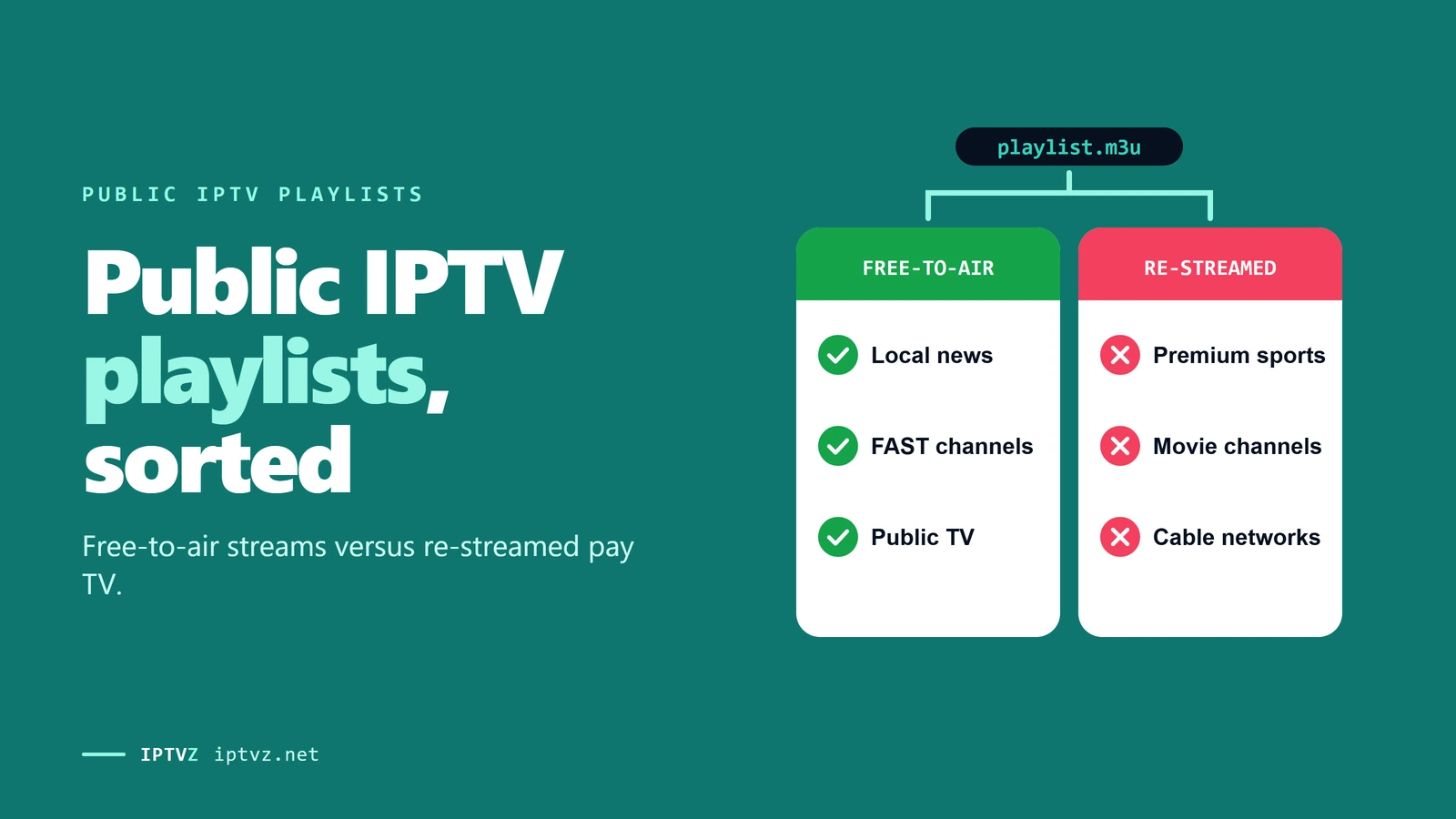
A public IPTV playlist is a free, volunteer-maintained list of TV streams that you load into a player app. The biggest one says it only collects streams that copyright holders made public on purpose, and most of its US entries fit that: 810 of 1,494 came from broadcasters, free streaming services and local government channels. But 123 entries sat on bare IP addresses, and that's where cable networks such as ESPN, CNN and Starz appeared. Watching official free streams is generally fine; a paid channel for free almost certainly isn't licensed.
The key point
"Public" describes the list, not the rights. Each stream on it is legal or not on its own, depending on whether the people who own the channel put it online for free.
This guide follows our look at IPTV playlists shared on Reddit. For how these lists perform, our test of free IPTV vs paid IPTV checked 120 of their streams.
What a public IPTV playlist is
About 12,100 people a month in the US search for a "public IPTV playlist". What they find, at the top of Google, is a handful of volunteer projects on GitHub. They collect the web addresses of live TV streams from around the world and publish them as M3U playlists, sorted by country, language and category. You add a playlist's link to a player app, and the channels load. No account, no payment.
The biggest of these projects is clear about its rules. Its legal note says it stores no video, only "user-submitted links to publicly available video stream URLs, which to the best of our knowledge have been intentionally made publicly by the copyright holders", and that rights holders can ask for links to be removed. Its moderators reject submissions that need a subscription or carry a login: their public labels show 93 submissions rejected as "subscription required" and 228 as "tokenized link".
That's the theory. To see how close the practice comes, we sorted the US playlist.
Where 1,494 US streams in a public playlist come from
We took the US playlist of the biggest project on November 4, 2026, with 1,494 entries, and grouped every stream by the address it plays from. An address shows who serves the stream, though not always who owns the channel. We didn't open or watch the streams.
Sorting a public playlist by where each stream comes from
The six kinds of source behind the 1,494 US entries
- Free ad-supported channels (524). The biggest single group: channels from the free streaming services and the companies that distribute them, including 214 Pluto TV channels that play through a third-party redirect. Many are themed channels; some are local news, with ABC, CBS, NBC and FOX affiliates' news streams among them.
- Public access and government (186). City council meetings, community access channels and state legislatures, from the services towns use to stream them. Dull, legal and stable.
- Broadcasters' own servers (100). News channels such as ABC News Live and CBS News city channels, public TV and Spanish-language news, played straight from the companies' own streaming domains.
- Owner not visible (558). Streams on big general hosts and content delivery networks, where the address doesn't say whose channel it is. Most look like small broadcasters: religious networks, small local stations and niche channels. We can't sort these further without opening them, so we don't count them as either side.
Where the cable networks hide: 123 bare IP addresses
The last group is the one to watch. 123 entries played from bare IP addresses, a raw server number with no company name, and 3 more from home-style dynamic-DNS addresses. That's where the familiar paid networks were: ESPN and ESPN 2, Fox Sports 1, NFL Network, NBA TV, the Big Ten and SEC networks, CNN, CNBC, Discovery, Disney Channel, Nickelodeon, AMC, Starz, Cinemax and dozens more.
These networks don't stream their channels free to the public; you watch them through a cable or streaming subscription. So whatever these addresses are, they aren't the networks' own free streams. When we tested 26 entries for 24 well-known pay channels on the same list in our free vs paid test, 16 responded, but only 2 were on hosts that looked like the rights holder's own. The rest were on bare IP addresses or third-party servers.
A pay channel on an unknown server can vanish whenever its operator stops, is blocked or is told to stop. And watching a paid channel without paying for it is the part of IPTV the law is concerned with. The list's own rules say these streams shouldn't be there, which is why they come and go.
Sports shows the split well. Of 68 entries in the sports category, 26 were free sports channels from the ad-supported services, and 15 sat on bare IP addresses, the ESPN-type networks. If you came for live games, those 15 are what you were after, and they're the least reliable entries on the list.
What gets removed from public playlists, and why
The project also publishes a blocklist: channels that can never be added. On November 4, 2026, it held 836 channels. 368 were blocked as adult content, and 468 after copyright complaints.
How channels leave a public playlist after a copyright complaint
The 468 copyright blocks came from just 19 complaints, and a few did most of the work. One complaint from the German football league in 2020 blocked 126 channels on its own. US channels on the blocklist include regional sports networks and, more surprisingly, six channels of the free streaming service Local Now, which filed its own complaint in 2022.
That last case teaches the most useful lesson in this guide. A channel can be free to watch in its own app and still not be free to copy into somebody else's list. Free services earn their money from ads and from where their channels appear; a playlist that bypasses the app can take both out of their hands, and some of them object.
The project's moderators are busy in both directions. Its issue labels show 24,755 requests to add streams and 4,893 to remove them, 2,064 submissions rejected as broken links, 189 rejected because the channel was blocked, and 47 handled as copyright cases.
What's usually fine to watch in a public playlist, and what isn't
US copyright law doesn't care what list a stream is in. It cares whether the people who own the channel put that stream online for anyone to watch. Use this table as a rule of thumb, not as legal advice.
| Kind of stream | Warning sign | Safer sign |
|---|---|---|
| News and public TV | A news channel you'd normally pay for, on a server with no name | The broadcaster's own free stream, the same one on its website |
| Free ad-supported channels | A free service's channel with its ads stripped out | Watching it in the service's own app, where it's licensed |
| Local government and access TV | Rarely a problem | Council, school and community channels streamed by the town itself |
| Sports networks | ESPN, regional sports networks or league channels for free | Free sports channels from the ad-supported services |
| Movie and premium channels | Starz, Cinemax or similar channels on a bare IP address | Free movie channels from a free streaming service |
| Region-locked streams | A stream marked "geo-blocked" that you reach with a VPN | Streams meant for viewers where you live |
| Any stream with a login | A link carrying a username, password or token | A plain public link; the project itself rejects tokenized ones |
US enforcement aims mainly at the people who run unlicensed services, not viewers, but copyright applies to viewers too. Our guide on whether IPTV is legal explains the law in more detail.
What the guides and AI answers claim about public playlists
The popular answers to "are public IPTV playlists legal?" are more confident than the data. One of the best-known guides lists ten public playlists, including the GitHub project we sorted, under the line "All the IPTV playlists on this list are legal", then adds a disclaimer that it doesn't verify legality. It also shows a virus scan of each playlist file as proof of safety. A playlist file is a short text list, so a clean scan says nothing about the streams it points to.
Google's AI Overview for "public iptv playlist" on November 4, 2026 said these repositories "only aggregate publicly available, free-to-air, or publisher-intended stream links". Our count says that's mostly true, but not entirely: 54% of the US entries were clearly official, and the cable networks on bare IP addresses clearly weren't. Google's AI Mode was more careful. It called the project a "legal gray area" and said a premium or cable channel for free from such a list "is likely a violation of copyright law". That matches what we found.
Why public playlists break
Public lists are maintained, so they break channel by channel rather than all at once. The US list marks 83 of its own entries as "not 24/7" and 73 as "geo-blocked". In our test of 120 random streams from it, 81% responded on the day. Channels drop out when a broadcaster changes its stream address, adds a block for outside players, or files a complaint. The pay channels on unknown servers are the most fragile of all.
That's the main difference from playlists passed around on social media, which usually die all at once because they're someone's account. Our guide to IPTV playlists from Reddit explains that side.
How to use a public IPTV playlist sensibly
- Use the official app where there is one
If a channel comes from Pluto TV, Tubi, The Roku Channel or a broadcaster's own app, watch it there. It's licensed, it's maintained, and the ads that pay for it reach the people who made it. Our guide to free live TV apps shows what they include.
- Pick the categories you need
The projects split their lists by country and category, such as news, public or legislative. A smaller list loads faster and leaves out most of the entries you'd question anyway.
- Skip the paid networks
If a list hands you ESPN, Starz or a regional sports network for free, that entry isn't what the project says it collects. Delete it or ignore it.
- Don't break region locks
A stream marked geo-blocked is meant for viewers somewhere else. Reaching it with a VPN can break the broadcaster's terms.
- Use a player from the app store
Any app that opens an M3U link will do. Install it from your device's official store, and add the playlist by its web address so it updates.
Where IPTVZ fits
A public playlist is a good free extra for news, public TV and local government channels. It's not built for what most people pay for: cable networks, live sports and full local stations. That's the gap a paid service fills.
- Test first: a free trial with no credit card, so you can check the channels a public list couldn't keep.
- Your own login: a playlist link and an Xtream Codes login for your account, in the player apps you already use.
- Written terms: a written 48-hour money-back guarantee for technical issues, on our refund policy page.
- What we can't claim: we don't claim licensing we can't verify. The same legal question applies to any paid seller, us included, and our guide on IPTV and the law covers it.
People also ask
These are the questions Google showed for "legal iptv", "free public iptv playlist" and "is iptv-org legal" on November 4, 2026 (US settings, results not personalized). Each one gets a straight answer first.
How do I know if my IPTV is legal?
Ask whether the people who own each channel are being paid for you to watch it. A licensed service, a broadcaster's own free stream or a free ad-supported app passes that test. A list that gives you cable, sports or premium channels for free, especially from servers with no company name, almost certainly doesn't. Our guide on whether IPTV is legal goes further.
Where can I get a playlist for IPTV?
Free playlists come from volunteer projects on GitHub, which sort public streams by country and category; paid playlists come from an IPTV service with your own login. Add either one to a player app by its web address. Avoid playlists passed around in forums and messages; they're usually someone else's account.
What is the best playlist for IPTV?
For free TV, the large volunteer-maintained lists on GitHub are the most complete and the best maintained. Their US section had 1,494 entries in November 2026, mostly free channels, news and public TV. For cable networks, sports and full local stations, no free list is reliable; a paid service with your own login is.
Can I find an M3U IPTV playlist for sports channels?
You can find free sports channels, but not the big sports networks reliably. In the US section of the biggest public list, 26 of 68 sports entries were free sports channels from ad-supported services, while the ESPN-type networks sat on 15 bare IP addresses that come and go and almost certainly aren't licensed. For live games, see our guide to the best IPTV for sports.
Is there any legal IPTV in the USA?
Yes. IPTV is simply TV delivered over the internet, and licensed services such as YouTube TV, Sling TV and Fubo work that way. Free services like Pluto TV and Tubi are legal too. Whether a smaller IPTV seller is legal depends on whether it has the rights to what it streams; our guide on whether IPTV is legal explains how to think about it.
What is the risk of using IPTV?
The most common risk is losing your money to a seller that stops working or disappears. You also hand the seller your email and payment details, and some sellers ask you to install apps from links outside the official app stores. If a service streams channels without the rights to them, there's a legal risk too, although US enforcement aims mainly at the people who run such services. Paying in a way you can dispute and testing before a long plan cut the biggest risks.
More questions about public IPTV playlists
Are public IPTV playlists on GitHub legal?
The lists themselves are links, not video, and the biggest project only means to collect streams their owners made public. Most of its US entries fit that. Some don't: 123 US entries sat on bare IP addresses, including cable and premium networks. Watching those is the part that's almost certainly not licensed.
Are public IPTV playlists safe?
The playlist file is just text, so it can't harm your device by itself. The risks are elsewhere: player apps installed from outside official stores, streams from unknown servers, and copies of lists edited by someone else. Use the project's own lists, and a player from your device's app store.
Why are some channels in public playlists geo-blocked?
Because the broadcaster only has the rights to show them in certain places. The US list marked 73 entries as geo-blocked in November 2026. Reaching them from elsewhere with a VPN can break the broadcaster's terms, and the stream may simply refuse to play.
Why do channels disappear from public playlists?
Stream addresses change, broadcasters block outside players, and rights holders file complaints. The biggest project has blocked 468 channels after 19 copyright complaints, one of which removed 126 channels at once. Pay channels on unknown servers disappear most often.
Do public IPTV playlists have local channels?
Some. The US list had 180 entries named after local stations, mostly local news streams from ABC, CBS, NBC and FOX affiliates distributed through free services. That's news, not the full station with prime-time shows. An antenna or a paid service gets you the full local channels.
Can I add a channel to a public IPTV playlist?
Yes, the big projects take submissions through GitHub, and their moderators check each one. They reject broken links, streams that need a subscription and links with a login or token: 2,064, 93 and 228 submissions respectively, according to the project's public labels.
Sources and data
- IPTVZ, source analysis of the US playlist of the largest public IPTV project on GitHub (1,494 entries), downloaded and grouped by stream address on November 4, 2026; no streams were opened.
- The same project's published blocklist (836 channels, with reasons and references) and legal note, read November 4, 2026.
- The same project's GitHub issue labels, counted through GitHub's public search on November 4, 2026.
- IPTVZ, availability test of 120 random streams and 26 pay-channel entries from the same US list, November 4, 2026, published in our comparison of free and paid IPTV.
Show all 7 sourcesShow fewer
- IPTVZ keyword research: Semrush US data for public playlist searches, collected November 4, 2026.
- IPTVZ, Google results, "People also ask" questions, AI Overview and AI Mode answers for "public iptv playlist", "legal iptv" and "is iptv-org legal", US settings, November 4, 2026.
- IPTVZ plans, playlist access and refund policy as published on iptvz.net, November 4, 2026.
Test it on your own TV
Which IPTVZ plan is right for you?
Both plans carry the same channels, movies and sports, with the same 48-hour money-back guarantee. Pick one and order right here.
Standard
- 19,000+ live channels, including 830 US local stations
- 80,000+ movies & series on demand
- NFL, NBA, MLB, NHL & PPV events
- 24/7 support by chat & email
$29.99
$10.00/mo · billed once
VIP
- Everything in Standard, plus:
- Free Hot Player or EBO Player activation for 1 year
- Premium Server
- Faster, priority support
$44.99
$15.00/mo · billed once
Not ready to buy? Start a free trial, no credit card needed.
- 48-hour money-back guarantee for technical issues
- Pay by card, crypto, bank transfer, Cash App and more
- Up to 5 devices and plans up to 5 years on the pricing page

Discover more
Explore our other guides & insights
From device setup guides to channel overviews: find everything you need to stream smarter.