

IPTV Scams: Red Flags to Check Before You Pay
Most IPTV scams give themselves away before you pay: in how the seller wants your money, where it wants to talk, and what it promises. We checked 72 IPTV seller websites for those signs. Here is what we found, how to pay so you can get your money back, and what to do if you already paid.
Who wrote this: IPTVZ sells IPTV subscriptions, so we compete with the sellers in this study. We don't name any of them; the numbers below show patterns, not verdicts on a company. Near the end, we run the same checks on ourselves.
The short answer: an IPTV scam shows itself in how it wants to be paid
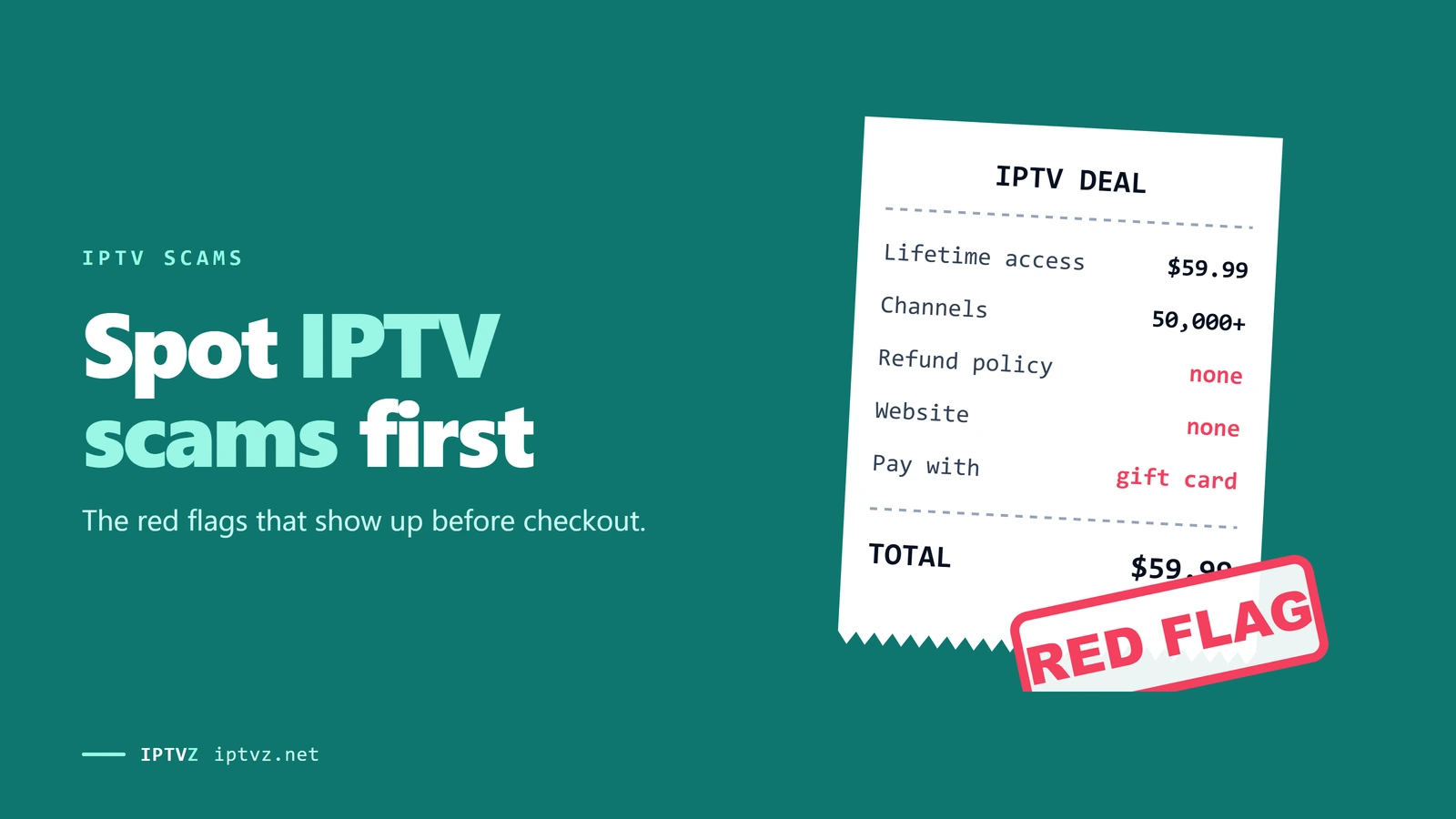
An IPTV scam is a seller that takes your money and delivers little or nothing: a service that never starts, stops after a few weeks, or a "lifetime" plan that ends when the seller disappears. The clearest warning signs come before you pay. The seller has no checkout of its own, no written refund policy, and asks for a payment you can't take back, such as gift card codes or a crypto transfer.
The key point
No single sign proves a scam, and plenty of honest small sellers take orders by chat. What protects you is the way you pay: a first purchase with a card or PayPal can be disputed, while gift cards, crypto and bank transfers usually can't.
This guide is part of our series on finding the best IPTV service in the USA. If you're still deciding which reviews to believe, start with our guide to IPTV reviews and paid lists.
What 72 IPTV seller websites showed
Between October 30 and 31, 2026, we opened the websites of 72 IPTV sellers that showed up in Google for US buying searches such as "IPTV subscription" and "IPTV free trial". From a US connection, we saved 533 of their pages: home, pricing, checkout links, refund terms, contact and FAQ pages. Then we counted what kept coming up. We didn't buy from anyone, so these numbers describe what the sellers say and how they sell, not how their service runs.
What 72 IPTV seller websites showed (Oct 30–31, 2026)
A few things stand out. Chat apps are everywhere: 62 of the 72 sites link to one, so a chat button alone tells you little. What matters is whether the chat replaces the checkout. Big promises are almost universal, and none of them can be checked from the outside. And 10 sites written for US buyers list only phone or chat numbers in the UK, Morocco or Pakistan. That isn't proof of anything, but it tells you the business behind a "USA" website may not be in the US, which matters the day you ask for a refund.
- A chat button is normal. A chat that replaces the checkout and the refund policy is the warning sign.
- Promises like "100% uptime" were on more than half the sites and can't be verified by anyone outside the company.
Nine IPTV scam red flags, and the safer sign for each
None of these proves a scam on its own. Two or three together, especially around payment and refunds, should stop you before you pay.
| What you check | Red flag | Safer sign |
|---|---|---|
| How you pay | Gift cards, crypto or a bank transfer only | A card or PayPal option you can dispute |
| Where you order | "Message us to order" in a chat app | A checkout on the seller's own website |
| Refunds | No written policy, or only "no refunds after activation" | A written refund window on a page you can link to |
| Contact | Only a chat-app number, often overseas | Email or live chat on the website, with answers in writing |
| Price | "Lifetime" for one payment, or far below every other seller | Prices in line with the market, with short plans available |
| Promises | "100% uptime", "8K", "every channel on earth" | Specific claims you can test during a trial |
| Pressure | "Price ends tonight", "pay in the next hour" | Time to test, with no countdown |
| Trial | No trial and no refund window | A trial or a refund window before a long plan |
| Business | No company name, no terms page, nothing about who runs it | A business name, terms and a history you can find |
The first three rows matter most, because they decide whether you can get your money back. A seller can have a slick website and still leave you with no way to recover a payment. A plain website with a real checkout, a written refund window and a card option is the safer bet.
When the checkout turns into a chat
The pattern we saw most often among the riskier sites goes like this. The website looks like any shop, with plans, prices and a "Buy now" button. But the button doesn't open a checkout. It opens a chat, usually in Telegram or another messaging app, and from there the conversation moves away from anything you could dispute.
A checkout that turns into a chat
What the website showsWhat happens after you click
In our study, 18 of the 72 sites sent buyers to a chat app to order instead of a checkout, and a few more used chat as their only support. Taking orders by chat isn't a scam by itself; some small sellers simply work that way. The risk is what usually comes with it: no order page, no receipt from a payment company, no refund terms you can point to, and a request to pay by gift card, crypto or a person-to-person transfer. If a seller moves you into a chat and then asks for any of those, you've lost every form of protection before you've watched a single channel.
How to pay for IPTV so you can get your money back
The Federal Trade Commission lists four signs of a scam, and the last one is about payment: scammers "often insist that you can only pay by using cryptocurrency, wiring money", "using a payment app, or putting money on a gift card", as its guide to avoiding scams puts it. The key word is "only". Plenty of honest businesses take crypto or bank transfers, including us. A seller that accepts nothing else is the warning sign.
Can you get your money back? It depends on how you paid
| How you pay | Can you dispute it? | What to know |
|---|---|---|
| Credit card | Yes, under federal law | The Fair Credit Billing Act covers things you paid for that weren't delivered as agreed. Your letter must reach the card issuer within 60 days after the first bill with the charge. |
| PayPal, paid as a purchase | Often | PayPal's Purchase Protection lets you open an "item not received" dispute within 180 days. Payments sent as "friends and family" aren't covered, so never accept a seller's request to pay that way. |
| Debit card | Sometimes | Many banks will look into a charge for something you never got, but the rules are weaker than for credit cards. Ask your bank before you rely on it. |
| Crypto | No | A crypto payment can't be reversed. If something goes wrong, the FTC warns, you're "likely to find that no one can step in" to help recover it. You're relying on the seller's own refund policy. |
| Bank transfer, wire or a payment app | Rarely | Once the money arrives, getting it back depends on the seller. Contact your bank right away if you were tricked. |
| Gift card codes | No | The FTC is blunt: "No real business or government agency will ever tell you to buy a gift card to pay them." Treat a gift-card request as a scam. |
For a first purchase from any IPTV seller, ours included, use a credit card or PayPal if you can, and buy the shortest plan that makes sense. If you prefer crypto or a bank transfer, that's a fair choice once you trust the seller. Just know you'll be relying on its written refund policy, so read it before you pay. Only 2 of the 72 sellers we checked listed gift cards as a way to pay; several others mention gift cards only to warn against them.
Promises nobody can check
Every seller says its service is fast and stable. Some promises go further than anyone could prove, and they are a useful test of how honest the rest of the site is.
- "99.9%" or "100% uptime". 39 of the 72 sites made this promise, and none of them can be checked from the outside. Any IPTV service has busy evenings and outages; a seller that claims it never goes down is telling you what you want to hear.
- Huge channel counts. Most of the sites claimed 20,000 channels or more. A big list can include foreign channels, duplicates and backup feeds of the same channel. What matters is whether your channels work, with a TV guide, at the time you watch.
- "8K" streams. We know of no US TV channel that broadcasts in 8K. A 4K channel is the most you should expect, and only with a fast connection.
- "Licensed" or "100% legal". 19 sites used words like "licensed" or "legal" about themselves or IPTV in general, and we couldn't verify a license for any of the 72. We don't make that claim about our own service either; our guide on whether IPTV is legal explains what the law covers.
Treat each of these as something to test, not something to believe. A free trial or a short plan will show you the channels, the guide and the busy-evening performance faster than any promise.
"Lifetime" IPTV plans: the deal that ends with the seller
15 of the 72 sites sold a "lifetime" plan: one payment, supposedly for good. Where a price was shown, it ranged from about $100 to $500. The problem is simple. Running live TV takes servers, bandwidth and support every month, so a one-time price only works if the seller keeps paying those costs from new customers. When the sales stop, or the service is shut down, "lifetime" ends, and nobody owes you a refund.
Compare that with a plan you can measure. At IPTVZ, one device costs $29.99 for 3 months, and our longest plan is 5 years for $259.99; we don't sell lifetime plans. Even with us, we suggest starting with a short plan and moving to a longer one once the service has proven itself on your TV. A long plan only saves money if the seller is still around to deliver it. We go deeper into the numbers in our guide to lifetime IPTV subscriptions.
Some of the scam advice is written by sellers
Search for "IPTV scams" and much of what you read was written by people selling IPTV. In our study, 13 of the 72 seller websites published their own advice on spotting scams. A lot of it is sensible, and some of it quotes US government consumer advice. But 4 of those 13 warned readers against "lifetime" deals, while 15 other sellers in the same study sold exactly that. The advice tells you what to avoid elsewhere; it rarely tells you how to check the seller giving it.
The search results themselves show the same problem. When we searched Google for "IPTV scams" on November 4, 2026 (US settings, not personalized), the first page included a Facebook group post, a Quora thread, two YouTube videos, one of them titled "My 3 Safe Providers", and a PDF titled "Avoid Scams Best IPTV Provider Reddit Recommendations" uploaded to the document portal of a New York State agency. A list of recommended sellers on a government file server is the kind of page our guide to IPTV reviews and paid lists describes. The checks in this guide work on any of them, and on us.
A 10-minute check before you pay any IPTV seller
Run these five steps before you buy anything longer than a month.
- Find the checkout
Click "Buy" and see where it goes. A checkout on the seller's own website, with your plan and price on it, is a good sign. A chat window, a contact form or "message us to order" means no order page and fewer ways to dispute.
- Read the refund policy
Look for a written refund window, what it covers and how to claim it, on a page you can link to. "No refunds after activation" with nothing else means your only protection is the way you pay.
- Check the payment options
Make sure a credit card or PayPal is offered, and use it for the first purchase. A seller that only takes gift cards, crypto or person-to-person transfers fails this step.
- Search the name
Search the seller's name with "reddit", "trustpilot", "refund" and "scam", and look up the website in ICANN Lookup to see when the domain was registered. Several unrelated people describing the same lost payment is the clearest warning you'll find.
- Test before a long plan
Use a free trial or the shortest plan. Check your local stations and their TV guide, a live game at a busy time, and the app you'll actually use. If a seller offers neither a trial nor a refund window, stop there.
If you already paid an IPTV scam
Move quickly. The time limits for getting money back start when you pay, not when you notice the problem.
- Save everything
Take screenshots of the website, the plan you bought, the chat or emails, and your payment receipt. Do it before the site or the chat account disappears.
- Dispute the payment
Credit card: contact your card issuer and dispute the charge as a service not delivered as agreed; under the Fair Credit Billing Act your letter must reach the issuer within 60 days after the first bill with the charge. PayPal: open an "item not received" dispute in your account. Debit card or bank transfer: call your bank the same day.
- Gift cards and crypto
Gift card: contact the company that issued the card right away, with the card and the receipt, and ask for your money back, as the FTC's gift card guide advises. Crypto: tell the exchange or app you used, but expect that the payment can't be reversed.
- Report it
File a report at ReportFraud.ftc.gov. The FTC can't resolve individual reports, but it shares them with over 2,000 law enforcement agencies and uses them to build cases.
- Watch for "recovery" offers
People who lost money to a scam often get a second contact offering to get it back for a fee. The FTC calls these refund and recovery scams. Don't pay anyone to recover your money, and change any password you shared with the seller.
The same checks, run on IPTVZ
It's fair to ask how we score on our own list. Here are the facts, including the ones that don't help us.
| Check | IPTVZ |
|---|---|
| Checkout | An order page on iptvz.net with the plan, devices and price |
| Payment | Card, Apple Pay, Google Pay, pay later, Cash App Pay, crypto and US bank transfer; PayPal by payment link. For a first order we suggest a card or PayPal. |
| Refunds | A written 48-hour money-back guarantee for technical issues |
| Trial | A free trial with no credit card |
| Support | Live chat and email; we don't take phone calls |
| Plans | 3 months to 5 years, no lifetime plans |
| Track record | In business since 2021; the iptvz.net domain was registered in 2026, so a domain lookup alone shows a young site |
| Licensing | We don't claim licensing we can't verify |
A young domain is exactly the kind of thing this guide tells you to notice, so don't take our word for the rest. Run the five steps above on us: start a trial, read the refund page, and pay for a first plan with a method you can dispute.
People also ask
These are the questions Google showed for "IPTV scams", "is IPTV safe", "is IPTV legit" and "legit IPTV services" on November 4, 2026 (US settings, results not personalized). Each one gets a straight answer first.
What is the risk of using IPTV?
The most common risk is losing your money to a seller that stops working or disappears. You also hand the seller your email and payment details, and some sellers ask you to install apps from links outside the official app stores. If a service streams channels without the rights to them, there's a legal risk too, although US enforcement aims mainly at the people who run such services. Paying in a way you can dispute and testing before a long plan cut the biggest risks.
Is watching IPTV illegal in the USA?
Watching IPTV isn't illegal in itself: IPTV is simply a way of delivering TV over the internet, and licensed services use it every day. The legal question is whether a particular service has the rights to the channels, movies and sports it streams. US enforcement aims mainly at the people who run unlicensed services, but copyright law applies to viewers too. Our guide on whether IPTV is legal covers the details.
Are there any legitimate IPTV providers?
Yes. IPTV is only a way of delivering TV over the internet, and licensed live TV services such as YouTube TV, Sling TV and Fubo deliver TV that way too. For smaller IPTV sellers, "legitimate" means two things you should check separately: whether it's a real business that delivers what you pay for, and whether it has the rights to what it streams. You can check the first with the steps in this guide; for the second, see our guide on IPTV and the law.
What is the safest IPTV?
The safest choice is a service you can test before you pay much, bought in a way you can dispute. We sell IPTV, so we won't rank other sellers. Look for a checkout on the seller's own website, a written refund window, support that answers in writing, and a credit card or PayPal option. Then start with a free trial or the shortest plan.
How much is IPTV per month?
Many IPTV services sell plans of several months at a time rather than month to month. At IPTVZ, one device costs $29.99 for 3 months (about $10 a month), down to $259.99 for 5 years (about $4.33 a month); VIP plans cost about 50% more. Be wary of "lifetime" deals: a one-time price for a service that needs running servers is a red flag.
Can IPTV be traced?
Yes, like any internet service. IPTV traffic goes to and from your connection's IP address, so the service you sign in to and your internet provider can see that connection, just as they can with Netflix or YouTube TV. The seller also holds the email and payment details you gave it, one more reason to choose carefully who you pay.
More questions about IPTV scams
How can I tell if an IPTV seller is legit?
Check four things before you pay: a checkout on the seller's own website, a written refund policy, a credit card or PayPal option, and a history you can find by searching the name with "reddit", "trustpilot" and "refund". Then test with a free trial or a short plan before you buy anything long.
Are lifetime IPTV subscriptions a scam?
Not every one, but they're a poor bet. Live TV costs money to run every month, so a one-time price lasts only as long as the seller keeps going. In our check of 72 seller websites, 15 sold lifetime plans at up to $500. A plan with a set length and a refund window is easier to measure.
Is it safe to pay for IPTV with crypto?
It's safe only if you trust the seller already. A crypto payment can't be reversed, so you rely entirely on the seller's refund policy. For a first purchase, a credit card or PayPal gives you a way to dispute the charge if the service never arrives.
Why do so many IPTV sellers use Telegram?
Chat apps are cheap, fast and work worldwide, so many small sellers use them for support; 62 of the 72 sites we checked linked to one. The warning sign isn't the chat itself. It's a chat that replaces the checkout and the refund policy, and asks you to pay by gift card, crypto or a person-to-person transfer.
What should I do if my IPTV service stops working after I paid?
Contact the seller in writing first and ask for a fix or a refund under its policy. If there's no answer, dispute the charge with your card issuer or PayPal straight away, save your receipts and screenshots, and report the seller at ReportFraud.ftc.gov.
Can I get my money back from an IPTV scam?
Often, if you paid by credit card or PayPal and act fast: a credit card dispute must reach the issuer within 60 days after the first bill with the charge, and a PayPal "item not received" dispute within 180 days of payment. Gift card, crypto and bank transfer payments are much harder to recover.
Where do I report an IPTV scam in the US?
Report it to the Federal Trade Commission at ReportFraud.ftc.gov. The FTC shares reports with over 2,000 law enforcement agencies. Report it to your card issuer, PayPal or the gift card company too, since they are the ones who can return your money.
Sources and data
- IPTVZ, websites of 72 IPTV sellers found in Google for US buying searches: 533 pages saved and checked by hand, US connection, October 30–31, 2026. No purchases were made.
- IPTVZ, Google results and "People also ask" questions for "IPTV scams", "is IPTV safe", "is IPTV legit" and "legit IPTV services", US settings, collected November 4, 2026.
- Federal Trade Commission, How To Avoid a Scam, read November 4, 2026.
- Federal Trade Commission, Avoiding and Reporting Gift Card Scams, read November 4, 2026.
- Federal Trade Commission, Using Credit Cards and Disputing Charges, read November 4, 2026.
- Federal Trade Commission, What To Know About Cryptocurrency and Scams, read November 4, 2026.
Show all 12 sourcesShow fewer
- Federal Trade Commission, Refund and Recovery Scams, read November 4, 2026.
- Federal Trade Commission, ReportFraud.ftc.gov, read November 4, 2026.
- PayPal, PayPal's Purchase Protection Program, last updated January 26, 2026, read November 4, 2026.
- ICANN, Registration Data Lookup Tool, read November 4, 2026.
- IPTVZ keyword research: Semrush US data for IPTV scam, legit and safety searches, collected October 29–30, 2026.
- IPTVZ plans, prices and refund policy as published on iptvz.net, November 4, 2026.
Test it on your own TV
Which IPTVZ plan is right for you?
Both plans carry the same channels, movies and sports, with the same 48-hour money-back guarantee. Pick one and order right here.
Standard
- 19,000+ live channels, including 830 US local stations
- 80,000+ movies & series on demand
- NFL, NBA, MLB, NHL & PPV events
- 24/7 support by chat & email
$29.99
$10.00/mo · billed once
VIP
- Everything in Standard, plus:
- Free Hot Player or EBO Player activation for 1 year
- Premium Server
- Faster, priority support
$44.99
$15.00/mo · billed once
Not ready to buy? Start a free trial, no credit card needed.
- 48-hour money-back guarantee for technical issues
- Pay by card, crypto, bank transfer, Cash App and more
- Up to 5 devices and plans up to 5 years on the pricing page
Sources
- consumer.ftc.gov: Guide to avoiding scams consumer.ftc.gov
- consumer.ftc.gov: Weren't delivered as agreed consumer.ftc.gov
- paypal.com: Payments sent as "friends and family" paypal.com
- lookup.icann.org: ICANN Lookup lookup.icann.org
- consumer.ftc.gov: FTC's gift card guide consumer.ftc.gov
- reportfraud.ftc.gov: ReportFraud.ftc.gov reportfraud.ftc.gov
- consumer.ftc.gov: Refund and recovery scams consumer.ftc.gov
- consumer.ftc.gov: What To Know About Cryptocurrency and Scams consumer.ftc.gov

 Buying guides
 Buying guides
 Buying guides
Discover more
Explore our other guides & insights
From device setup guides to channel overviews: find everything you need to stream smarter.